Read now the follow-up to this article: « Anthropocena »: the last supper? Or read here in french.
Do you feel the toxic touch of the word “Anthropocene”? If you don’t, just consider the following. Attributing the near-collapse of our planet to the Anthropos in general means that we hold the Inuit or Jivaros as much responsible for the situation as our modern Western civilization. This sounds absurd, doesn’t it, since they are among the first victims of capitalist greed, deforestation and climate change, and the last defenders of our forests and ice caps. And all in the name of « universal humanity » (aka the Anthropos), a concept these peoples never asked for or supported. In other words, we confuse victims and predators when we use the word Anthropocene as the « age of man ». It all sounds like the Western empire’s latest dirty joke.
« Capitalocene », originally proposed by Andreas Malm, is a much more satisfactory option. That’s why we use it on this blog. However, it’s still a somewhat vague concept, fraught with ambiguity as to whether to point the finger at capitalism as such or private property, the invention of money, or the first states, or slavery, patriarchy and so on (all of which form a complex history that we explore on Symbiosphere).
We suggest here that the history of modern capitalism is being transformed into a global technoculture of entropy. Entropy refers to the second thermodynamic principle according to which, in any system, a certain amount of energy will be irreversibly converted into heat (i.e. lost forever), leading to the degradation of matter and energy in the universe towards an ultimate state of inert uniformity. Entropy is the general tendency of the universe towards disorder… and death. It’s no laughing matter, I admit. But it’s a pretty perfect definition of climate change, as the product of blind economic development in the context of neoliberalism and the religion of Growth.
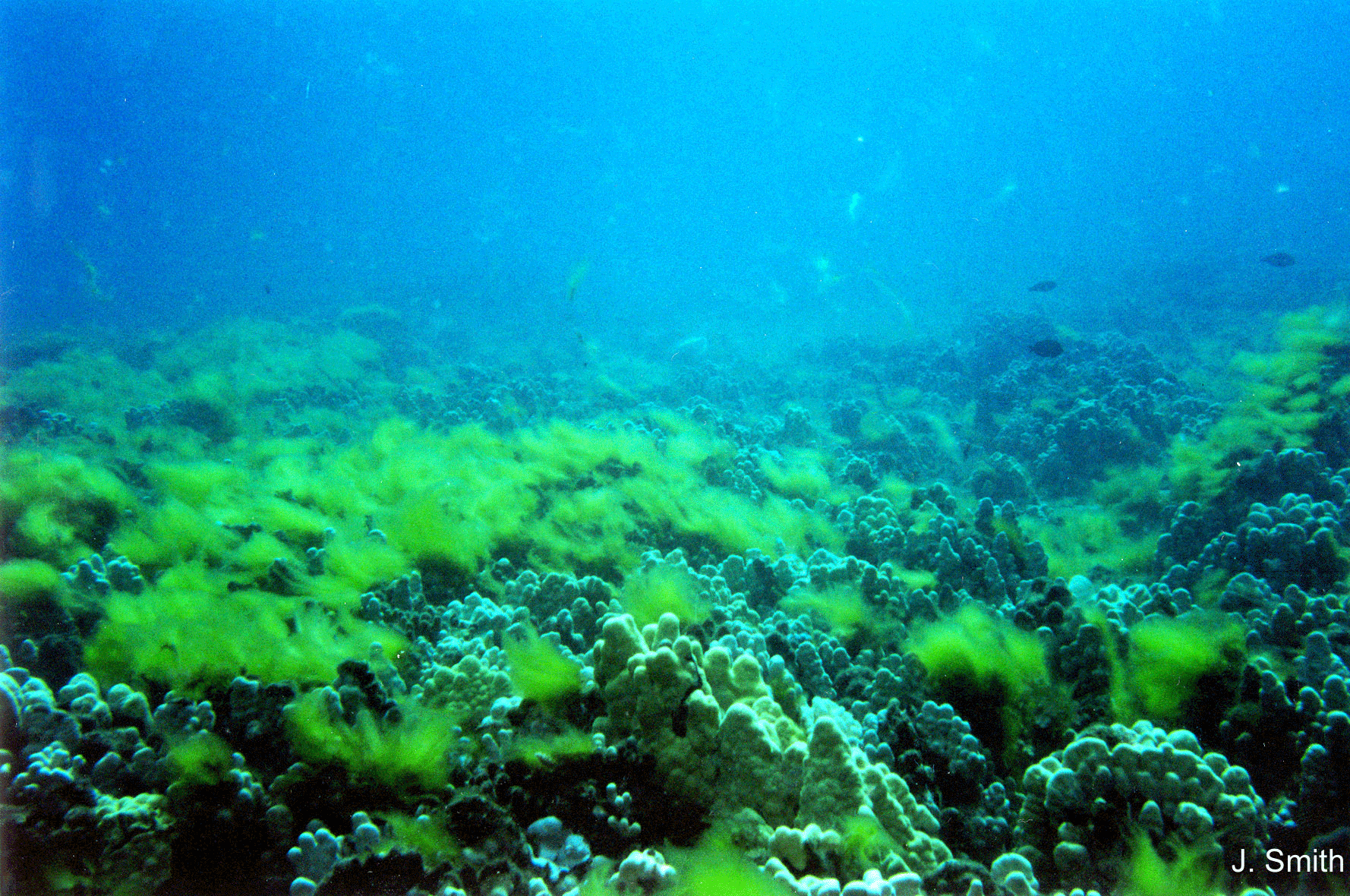
At a time when GAFAM and the UBER-economy have invaded not only the most distant territories, but also the most intimate parts of ourselves and our social relationships, it appears that entropy is not just the result of our economic madness, but the very shape of a new dissipative culture. In this sense, we are witnessing an entropization of the social field, with the use of marketing and big data, focusing on individuals, or rather on bits and pieces of them: their instant feelings, their dispositions to like or dislike. All with the aim of boosting numbers and accelerating the pace of transactions and profit And ecosystems are also entropized, which often equates to « eutrophied » (a word from ecological science), resulting in simpler, less diverse and less resilient landscapes, resulting from and/or designed for rapid and brutal exploitation.
The entropization of society and ecosystems is not exclusively the result of the blind course of economic forces, nor is it due to so-called human nature or some innate anthropological tendency. In The Shock Doctrine, Naomi Klein insists that political and social disintegration (sometimes presented by economists as « necessary » for wealth creation) was in fact a conscious strategy, planned and theorized, notably by Milton Friedman and his « Chicago Boys », and experimented with on a large scale in South America with the participation of the CIA. Designed to rapidly gain the upper hand in the event of economic, social and natural disasters (e.g. Katrina), this conceptual system, dubbed « disaster capitalism » by Klein, reached maximum acceleration under the reign of Facebook, Big Data and high-frequency trading.
This general and accelerated process towards maximum disorder, leading to social and political dislocation, and transforming the (sym)biosphere and the fossil energy of the soil into carbon dioxide and heat (energy lost forever, or at least for a very long time), is a correct, if broad, definition of entropy. This is why it may be worth considering the word « Entropocene » as an easy alternative to « Anthropocene ».
Resistance to the Entropocene is best expressed by the concept of « negentropy » (used by Bernard Stiegler), or that of « autopoiesis » (Félix Guattari), emphasizing the potential of living processes, from the smallest cell to ecosystems, human cultures and societies. The complexity and diversity of life appear as a response to the universe’s tendency towards dissipation. Herein lies the true and precious « singularity ». The universal pretension of the « Anthropocene » concept also misses the potential for inventing and maintaining negentropy in human cultures. So, as well as insulting non-modern, non-Western, non-capitalist human beings, the « Anthropocene » vision robs us of great inspiration. In our article « The Indigenous Principle », for example, we discussed the skills of the indigenous way of thinking to resist disaster capitalism, in addition to indigenous expertise in « managing » their environment in a resilient way.
A probably rare case of negentropy in the universe is the terrestrial biosphere itself, « Gaia », as it was nicknamed by scientists John Locke and Lynn Margulis in the 1970s. On this blog, we use the word « symbiosphere » to refer to the many processes and relationships that together preside over the formation of the Earth’s crust, planetary biodiversity and protective gaseous atmosphere. It expresses itself in the flesh and soul of every living being. And it is precisely the opposite process of entropification, which transforms the product of life into an enormous mess of dead particles ruining the atmosphere. Global warming.
Read the follow-up: « Anthropocena »: the last supper?

 symbiosphere